


The agents could not authenticate how the manuscript had evolved. No detector could have saved it. That gap is why I threw out version 1.0 of my own authorship protocol and published a different one today.
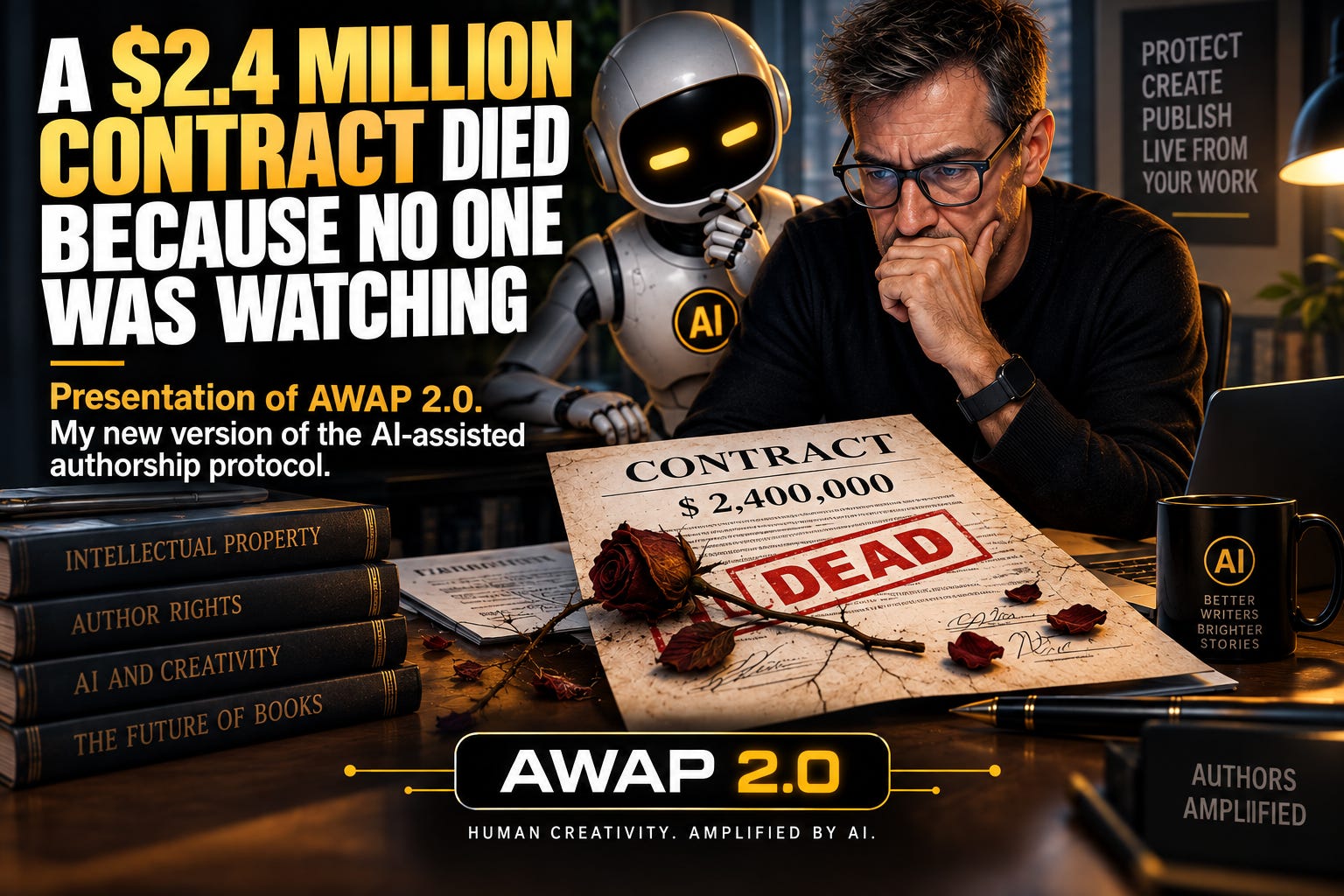
On 29 July 2026, a debut crime novel that had sold at a fourteen-way auction for roughly $2.4 million stopped existing commercially. Minotaur had bought Call Me, I’ll Hide the Body by Jerry Falade. HarperCollins held UK rights. A film was in development. Then his own agents withdrew the manuscript, and the reason they gave was not that a detector had flagged the prose. It was that they could no longer authenticate how the manuscript had evolved from origin to completion.
Read that again, because it is not a sentence about artificial intelligence. It is a sentence about evidence.
Falade says he used AI only for research. I do not know whether that is true, and neither do you, and — this is the part the industry keeps refusing to absorb — neither did his agents, and neither does any software they could have bought. What they had was a finished file and a bad feeling. What nobody had was a record.
Before I go further: I wrote the specification I am about to describe, I published it this week under a Creative Commons licence, and I sell a commercial implementation of it. The spec is open and anyone can implement it, including against me. Read everything below with the suspicion that combination deserves.
Here is what I want to defend. Nobody can prove that a text is human. What can be proved is from what point in the life of a work a record exists, and what the author did inside what was recorded. Those are two facts about two different windows. The central mistake of the last three years — mine very much included — has been trying to crush them into a single number.
Plagiarism trials settled this argument decades ago
Courts have been deciding contested authorship since long before anyone could generate a paragraph on demand, and they never once asked the question our industry is obsessed with.
In an American copyright suit the plaintiff must show access and substantial similarity. The defendant’s classic answer is independent creation, and independent creation is proved the same way it has always been proved: with drafts, notebooks, dated manuscripts, correspondence, the false starts. As one law review puts it, evidence concerning the manner in which the defendant created the work is logically relevant. Document metadata and tracked changes get used the same way, to fix a timeline that a finished file cannot fix on its own.
Notice what a court does with those two things. It asks since when you have evidence, and it asks what the evidence shows. Then it weighs them separately. No judge has ever averaged “he has drafts going back to 2019” with “the drafts are detailed” to produce a single authorship figure out of a hundred, because that figure would answer no question anyone actually asked.
That is the whole idea I tried to encode three years ago, and the first version I shipped got it wrong in a way that took me until this summer to see clearly.
Version 1.0 scored things it had never seen
AWAP 1.0 rated a work by which foundational documents existed — premise, bible, outline, style notes — and by how much of the AI’s text the human had revised. It produced one number between 0 and 100. It was in production, it issued certificates, and it had three problems that I now consider disqualifying.
It rewarded claims it could not observe. A premise document scored the maximum whether the record had watched it being written or the author had dropped the file in afterwards. That is not a rounding error, it is the protocol certifying a claim it had no evidence for — the precise failure I built the thing to avoid. An instrument that cannot tell the difference between witnessing and being told is not an instrument.
A single number invites exactly one question: is it high? Once one figure exists it is the only thing anyone reads, and in a dispute it becomes the single surface to attack. Knock down the number and the whole document falls. Worse, a single figure implies a single underlying quantity — the “humanity” of a book — and no such quantity exists.
It had no place for the most common case in publishing. An author arrives with a finished manuscript and wants to document the rewriting. Editors, ghostwriters, and everyone working on a book that already exists live in this case. Version 1.0 could only score it low, as though documented editorial work were a failed version of writing from scratch. That is both useless and insulting.
So version 2.0 replaces it in full. It is not backwards compatible, and old certificates stay valid only as what they are: 1.0 documents, whose scores cannot be compared to the new ones.
AWAP 2.0: https://github.com/raisepreflop/open-awap
Two questions, and never one number
What replaced the single figure is two measurements that the specification forbids combining.
The first is coverage: from what point in the life of the work does a record exist? A project that enters when nothing but an idea exists has total coverage. A project that enters as a finished manuscript has very little, because almost the entire life of that book happened where no one was looking. The decisive detail is that the author does not choose this. Coverage is derived from the state the work was in when the record first saw it, it is fixed once at entry, and it never moves again.
The second is authorship inside what was observed: within the recorded window, how much of the work was the author’s? This one is computed only from logged events — never from scanning the finished text — and the weights are published. Words the human actually wrote weigh most, decisions about plot, character, point of view and ending weigh nearly as much, and writing prompts weighs least of all, because instructing a machine has never been the same thing as authoring a work.
Those two numbers describe different windows, so the spec prohibits merging them in any form, and it names the temptation explicitly: including a weighted average “for internal use only”. Every institution that adopts this will want that average by the second week. It does not exist, and pretending it does would rebuild the flaw I just spent a year removing.
The entry point also determines which of two tracks a work is on. Enter with a premise, a bible or an outline and you are on the origin track. Enter with a partial draft, a finished manuscript or a bare file and you are on the transformation track, where the score carries a different name precisely so that nobody compares it to a score that means something else.
There is one rule that matters more than any of the arithmetic. With no observed writing, there is no score at all. A manuscript nobody watched being written cannot come out at 100 for “no AI text retained” — it lands in the unaccredited quadrant with no figure attached.
Everyone else is answering a different question, and answering it well
The existing options are not frauds. They are good answers to a question that is not this one, and it is worth being exact about where each stops.
The Authors Guild’s Human Authored mark opened to all US authors on 2 March 2026, at $10 a title for non-members, with identity verification through a third party. It has something my protocol does not: real legal teeth, because a false claim exposes you to trademark and consumer-fraud liability. What it verifies is who is making the declaration, not what happened while the book was written. The Guild says so itself, with a candour the rest of the sector should copy: it is not aware of any truly reliable way to test whether a work includes AI-generated material.
Amazon’s KDP asks you to tick whether content is AI-generated or AI-assisted. Amazon neither verifies the answer nor shows it to the reader.
Timestamp registries — Safe Creative and their equivalents, and the official registries in civil-law countries — do something stronger than either: they establish that a specific file existed on a specific date, and in some jurisdictions they shift the burden of proof onto whoever disputes it. That is more legal force than a process record will ever have on its own. But they seal the artefact, not the making of it. They prove the file existed on Tuesday, not that you wrote it.
And then there are the detectors, which deserve better treatment than they usually get from people in my position. Pangram advertises 99.98% accuracy, and a University of Chicago Booth working paper from August 2025 measured it at no worse than 99.8% on a controlled corpus. Those numbers are real. The failure is not in the model, it is in the deployment: a probability is being read as a verdict by institutions with no procedure for being wrong.
The best witness against that practice is not me. On 26 May 2026 the Authors Guild — the organisation behind the competing seal — ran ten articles published before 2022, which no machine could have written, through five consumer detectors. ZeroGPT scored them between 5% and 76% AI, including 66% on a Joan Didion obituary. Sidekicker flagged every single one at between 71% and 100%. The Guild’s conclusion was that no publisher should ever cancel a contract on detector evidence alone.
The same publisher, two opposite verdicts
If a score were a verdict, it would at least be applied consistently. It is not, and 2026 has given us the controlled experiment.
In March, Hachette pulled Mia Ballard’s horror novel Shy Girl after a 78% AI score from Pangram circulated publicly. The US edition was cancelled, the UK edition withdrawn. Ballard denies using AI and told the New York Times her name was ruined for something she did not do.
In June, Grand Central — an imprint of the same Hachette Book Group — published The Aesthetic Revolution by the fitness scientist Mike Israetel. On 21 May, a month before publication, Israetel had posted publicly: “I 100% used AI to help me smooth over some of the prose for my upcoming book.” He added that the publisher’s editors had been told. The book came out on 23 June and remains on sale.
One author denies using AI and loses the book. Another announces it in advance and keeps the book, the imprint and the sales. I am not arguing that Israetel did anything wrong; he disclosed, which is exactly what everyone says authors should do. I am arguing that the variable deciding these outcomes is not the text and not the score. It is the platform, the sales, and how nervous the institution feels that week.
There was a third case, and it completes the picture. Jamir Nazir’s story won the 2026 Commonwealth Short Story Prize and scored 100% AI on Pangram. Granta and the Commonwealth Foundation stood by it. Same instrument, same maximum reading, opposite institutional response.
A standard that produces opposite outcomes from identical evidence is not a standard. It is a mood.
What a false positive costs: my arithmetic
The data to compute this exactly does not exist, so what follows is my estimate with the method in plain view.
Assume a mid-sized house screens 2,000 submitted manuscripts a year and treats 70% as its rejection threshold. Those two numbers are my assumptions, not measurements, and everything below scales with them.
With a lab-grade detector at the roughly 1% false-positive rate the Chicago Booth paper supports, that is 20 clean manuscripts a year wrongly flagged at one publisher. Now take the subset most exposed: writers working in English as a second language. The Stanford study published in Patterns in 2023 found seven detectors misclassifying TOEFL essays as AI 61.22% of the time. If 400 of those 2,000 submissions come from non-native writers, that rate would mean 245 of them flagged. I do not believe that figure holds today — the study is three years old, it used short student essays, and the tools have improved — so I will divide it by five, generously, and call it 49.
Between 20 and 69 clean manuscripts rejected per year, at one house, by a policy its own staff would describe as rigorous.
The number is not the point. The asymmetry is. A false negative means a book gets published that maybe should not have been, which the market absorbs the way it has absorbed bad books forever. A false positive means a career ends before it starts, and 2026 has already put names and figures on that: $2.4 million, a cancelled US edition, a name its owner says is ruined. Those costs are not symmetrical, and no threshold can make them so.
The record proves less than you want it to
Now the part that costs me something, because a specification that only lists its strengths is marketing.
A process record does not prevent fraud. You can paste text in as if you had typed it. You can generate a manuscript elsewhere and register only the rewriting — that is not a loophole, it is literally the transformation track, and the declaration about where the text came from is recorded and never verified. You can backdate events on your own machine. The specification publishes all of this in its attack-surface section rather than hiding it, and the honest framing is the one it uses: AWAP does not stop any of that, it just refuses to certify what it did not see.
Second, and worse for me: the rule I am proudest of punishes the most human writer in the room. No observed process means no score. A novelist who spent twenty years writing longhand, with no registry anywhere near her, lands in the unaccredited quadrant and there is no honest way to lift her out. A human-authorship protocol that cannot accredit the most human author alive is a real limitation, not a quirk, and anyone who adopts this should know it before they sign anything.
Third, the thing is not finished. Three parts of the spec — the public anchoring of the certificate hash, the machine-readable credential, and the measurement of how deep a transformation goes — are specified and implemented nowhere, mine included. Until the anchoring exists, a certificate is a document you hold, not something a third party can check against a public registry, and the spec requires every certificate issued today to be marked provisional for exactly that reason.
And the strongest objection is one my own analogy hands to the other side. In See v. Durang, back in 1983, the Ninth Circuit declined to examine the drafting process at all and compared only the finished works. If a court decides that process is not what it is looking at, process evidence is worth nothing in that room. Forensic linguistics does not rescue this either: it was built to tell human authors apart, not to tell a human from a machine.
The answer
What survives all of that is smaller than a certification mark and more useful than a score.
AWAP does not issue verdicts. It produces discovery material: the modern equivalent of the drafts a defendant pulls out to prove independent creation. When a work enters with a manuscript already written, the protocol seals that starting file by hash, runs a provenance scan and stores the result whole whatever it says, and blocks until the author signs a declaration about where the text came from. On the certificate, the origin section is not hidden — it stays visibly empty. A document that shows its own hole is worth more than one that papers over it.
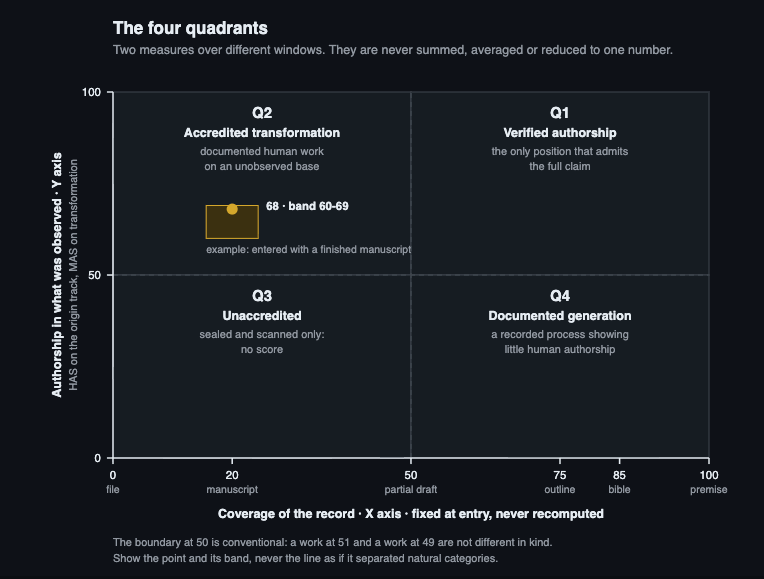
The record is private by default. What can leave the author’s machine is hashes, counts, states and decisions. Never the text, never the prompts.
And every certificate carries the same fixed paragraph, which is the part I would keep if I had to throw out everything else:
“This certificate does not accredit the origin of any text predating the date of entry into the registry. It contains no AI-text detector and does not rely on one. It does not claim the work is ‘human’, ‘AI-free’, or any single percentage of humanity. Coverage and the score are different measures over different windows: they are not summed, and they are not compared across quadrants. AWAP does not prevent fraud: it makes the certificate state only true things.”
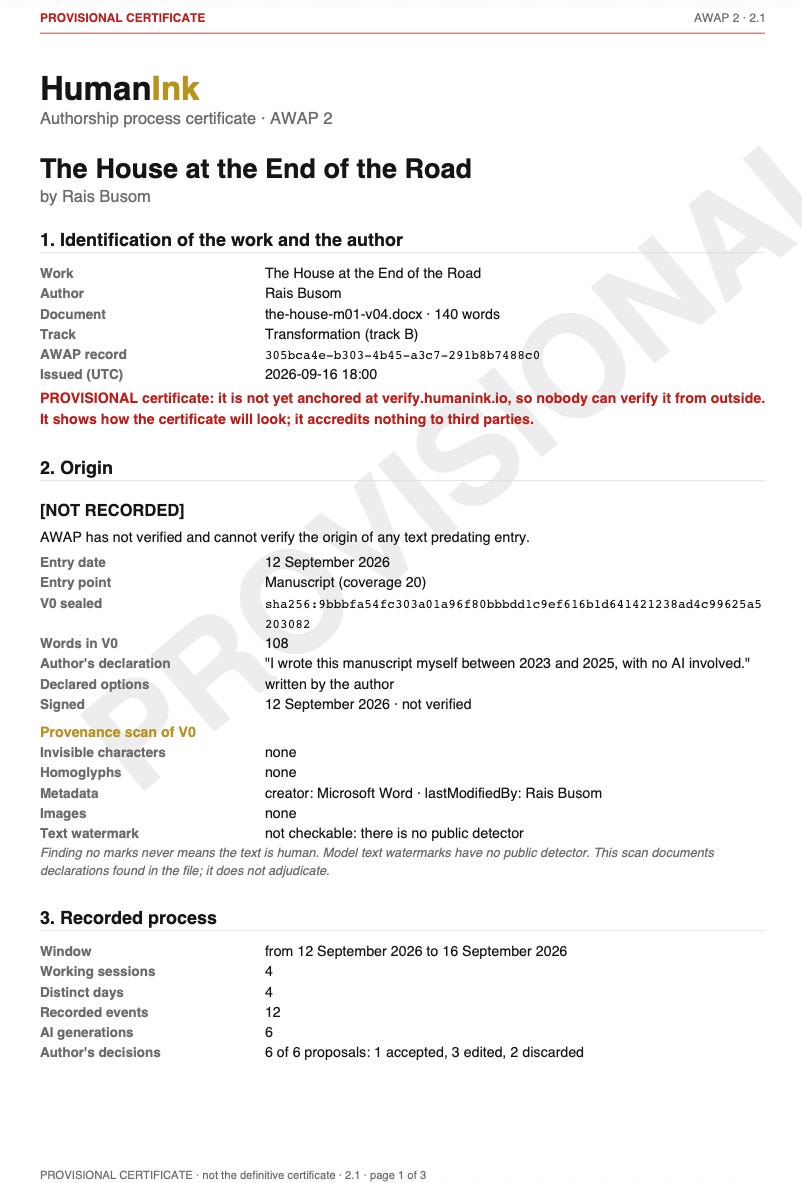
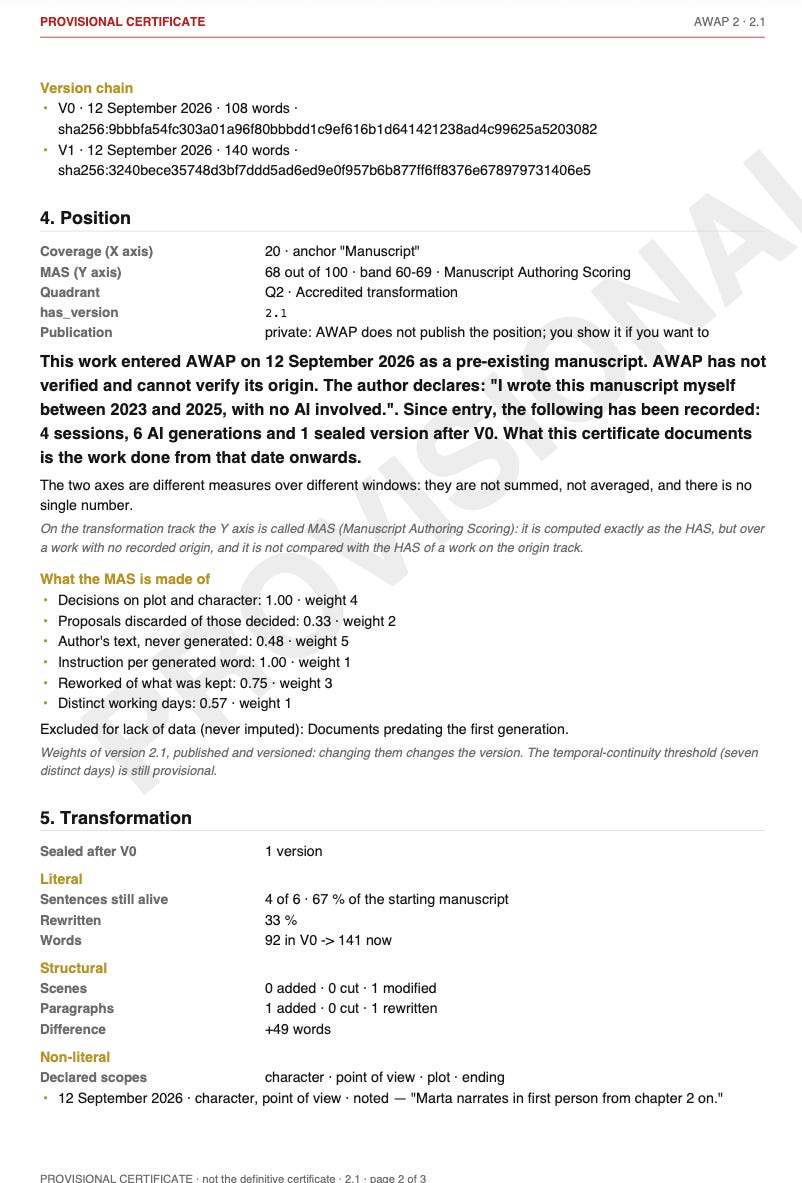
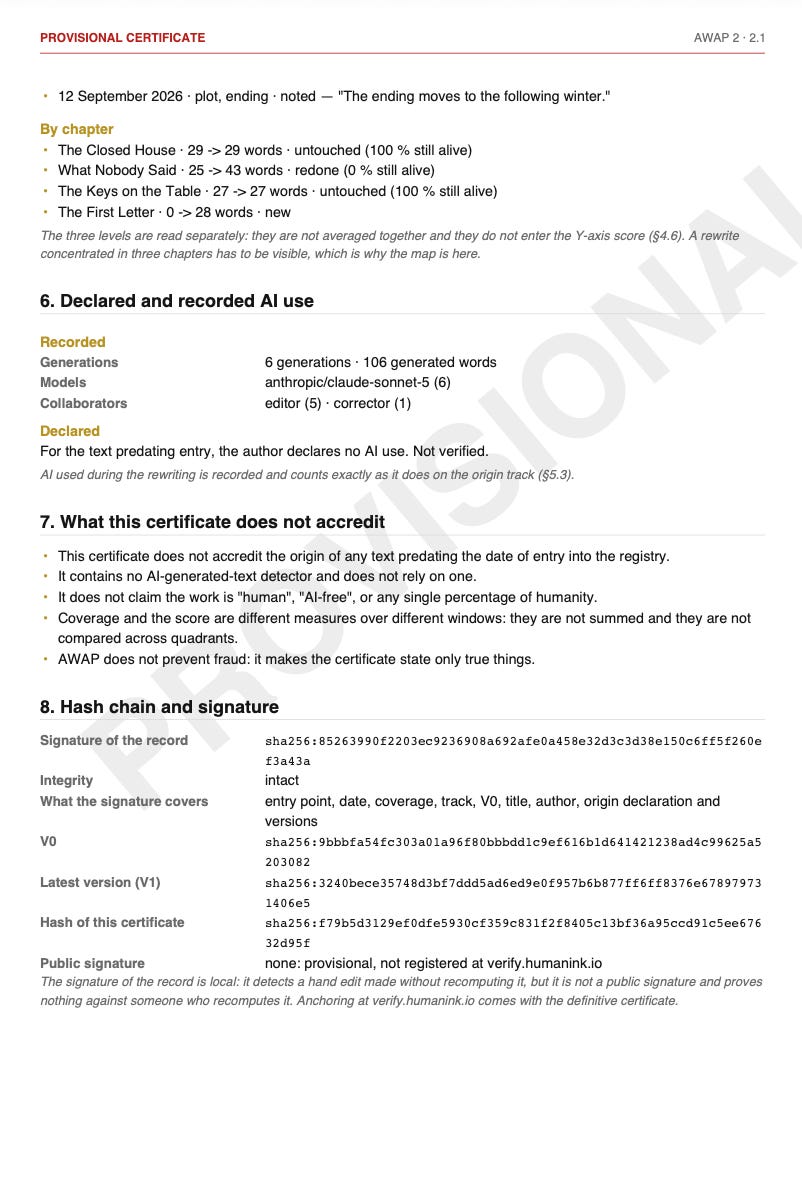
That last line is the entire argument. Publishers do not need an oracle that rules on humanity, because no such oracle can exist. They need what every other contested-authorship dispute in history has run on: a party that can show its work.
The specification is at github.com/raisepreflop/open-awap, under CC BY 4.0. Implement it, fork it, compete with my implementation. A standard that only one company can run is not a standard.
So, a question with a real cost attached. If your editor asked you tomorrow to show how your manuscript evolved from the first note to the last line, what could you actually produce today? And the harder half: would you write inside a record that watches your process, in exchange for being able to prove it?
Rais Busom. Fiction and non-fiction writer, entrepreneur, independent publisher, Certified Literary Coach, and expert in AI applied to writing. Founder of the Spanish-speaking writers’ community *Escritores Aumentados* and HumanInk.io—a platform featuring 18 virtual editorial collaborators for skilled writers and offering official AI-Assisted authorship certification.
Sources
Jerry Falade, Call Me, I’ll Hide the Body: deal withdrawn 29–30 July 2026 after agents said they could no longer authenticate how the manuscript evolved from origin to completion. Publishers Marketplace, 30 July 2026; Wall Street Journal; The Guardian, 31 July 2026.
Mia Ballard, Shy Girl: pulled by Hachette, March 2026, following a publicly circulated 78% Pangram score. TechCrunch, 21 March 2026; New York Times.
Mike Israetel, The Aesthetic Revolution (Grand Central / Hachette Book Group, published 23 June 2026). Author’s public statement on X, 21 May 2026: “I 100% used AI to help me smooth over some of the prose for my upcoming book.”
Jamir Nazir, “The Serpent in the Grove”, 2026 Commonwealth Short Story Prize: 100% Pangram score, story upheld by Granta and the Commonwealth Foundation. WIRED, Lexi Pandell, 2 September 2026.
Authors Guild, Human Authored certification: FAQ and expansion to all US authors and publishers, 2 March 2026, $10 per title for non-members.
Authors Guild, “Can AI Detectors Be Trusted?”, 26 May 2026: ten pre-2022 articles tested against five detectors; ZeroGPT 5–76%, Sidekicker 71–100%.
Pangram accuracy: vendor claim of 99.98%; Jabarian & Imas, “Artificial Writing and Automated Detection”, Becker Friedman Institute Working Paper 2025-116, August 2025.
Liang, Yuksekgonul, Mao, Wu & Zou, “GPT detectors are biased against non-native English writers”, Patterns, 2023: 61.22% average false-positive rate on TOEFL essays.
US Copyright Office: registration guidance on AI-generated material, effective 16 March 2023; Copyright and Artificial Intelligence, Part 2: Copyrightability, 29 January 2025.
Independent creation and process evidence in copyright litigation: Fordham Intellectual Property Law Journal, “Substantial Similarity and Junk Science”. See v. Durang, 692 F.2d 1310 (9th Cir. 1983).
Open AWAP 2.0 specification: github.com/raisepreflop/open-awap, CC BY 4.0, September 2026. All quoted certificate language, the two tracks, the coverage anchors, the attack-surface section and the implementation status are from that repository.
The screening arithmetic in “What a false positive costs” is my own estimate, with its assumptions stated in the text.